What you bring
A hall or warehouse in NRW, cameras with access to the image, a recurring task and a person who knows the workflow.
You have a repetitive task. We assess the robotics approach and develop the combination of hardware, controls and software — turning it into a workflow you can test.
One concrete process is enough to get started.
Today a camera detects an event and a person has to react. In LOOP the loop closes: the job is created from the camera image, an AI dispatcher assigns it to a robot, and the camera checks the result. People approve exceptions only. Existing cameras, robots from different manufacturers, no rebuild of the hall. Each step shows what already runs today.
Video analytics on existing cameras detects that something needs doing: material is missing, an area is dirty, a zone is blocked. View ↗
An AI dispatcher turns this into a job and assigns it to the right robot, including devices from different manufacturers. View ↗
Mobile robots and robot arms take on transport, sorting or cleaning. View ↗
The same camera checks whether the job is done, with an image model that describes activities instead of only counting objects. Only then does the loop close.
Routine runs through. Anything unusual or with consequences goes to the responsible person for approval. View ↗
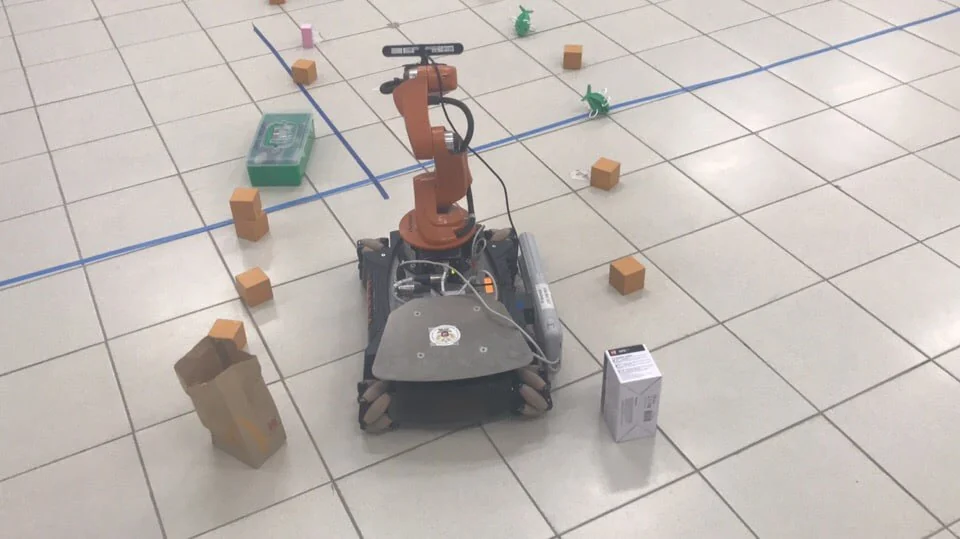
We are looking for three businesses with a hall or warehouse, existing cameras and a task that recurs every day: bringing material, cleaning areas, checking stock. For this one task we build the loop together, first in simulation with your floor plan, then in a test run on site.
A hall or warehouse in NRW, cameras with access to the image, a recurring task and a person who knows the workflow.
Simulation with your floor plan, a test run on site, a measurement report with results and limits, and priority when LOOP goes into regular operation.
After a conversation and a site visit. What counts is a clear task, measurable benefit and room for a safe test.
Move materials, containers or components along recurring routes. We assess paths, transfer points, loads and obstacles.
A manipulator with a gripper picks, sorts and feeds parts; the camera guides it to the right one.
Capture visible features or events with cameras and integrate them into an agreed control or alert workflow.
A specified workflow with the agreed hardware, software and interfaces.
A test report covering agreed measures, identified limits and outstanding work.
A proposal for the next scope, effort, responsibilities and operation.
Our team does not just integrate robots, it also builds and programs them. Two examples from our own workshop.
In 2023 our team built an interactive terminal for an event provider: housing, screen, card dispenser and the software that controls it all. The same combination of device, interface and workflow is behind parking terminals and locker systems.
Our project background combines mobile robots, robot arms, robot control and image processing with custom enterprise software. In a conversation, we discuss development work relevant to your task and define a suitable project scope.
Before you spend any money, we look at your workflow. You get an honest assessment and a fixed price for the next step.
You show us the workflow in a video call, ideally with a short phone video or a few photos in advance.
Approach, feasibility, limits and a fixed price for the next step, a check or a pilot. Plus a note on whether a funding programme could fit.
No obligation. “Better not to do it” is a possible result too.
Examples with workflow, deliverable and pilot scope. They are concepts for a first pilot, not completed client projects.
We automate a recurring material route between storage and assembly. The pilot connects a material request, robot transport and confirmed handover, using a defined container within a clearly bounded work area.
See the workflow & deliverables ↗We introduce a cleaning robot for a selected area of your building. The pilot combines the automated cleaning run with preparation, manual finishing and a documented quality check by your team.
See the workflow & deliverables ↗We automate checkout and return for selected tools using a cabinet with controlled compartments. The pilot combines access permissions, tool identification and a traceable handover record, while the responsible team retains condition checks.
See the workflow & deliverables ↗We connect service request handling with preparation and robot transport of the required parts kit. The pilot brings one clearly defined workflow together, from a reviewed request to confirmed handover to your technician.
See the workflow & deliverables ↗No. We start with the task, the site and your objective. Hardware and peripheral selection follows the technical assessment.
We assess the available controls, interfaces and access rights. The pilot can start with one clearly defined connection.
Selection follows the task. We assess suitable platforms and establish availability, documentation, interfaces and requirements for operation.
Before deployment we establish roles, operating limits, safeguards and required checks. An experimental setup and a system approved for daily operation are different project stages.
The feasibility check costs from €1,490 and is credited towards the pilot. Effort depends on the task, hardware, environment and interfaces. Once we narrow the scope, we define deliverables, acceptance criteria and a proposal. Hardware, development and operation are considered transparently.
Tell us about a process that takes up your team’s time. We discuss where automation could help and what is needed to define the next step.
For robotics, useful details include the task, cycle or frequency, part or load, existing equipment and site.
Your effort: one person who knows the workflow, access to examples, a kickoff conversation and the decision after the pilot. We handle integration, setup and coordination with vendors. What we take on ↗
HEINRICH SCHNEIDER / DDC
heinrich@ddc.companyPrefer email? Write to us directly.
Contracting party: M2D GmbH, Am Turm 11, 53721 Siegburg · initial call free of charge · Pricing · Security & data protection